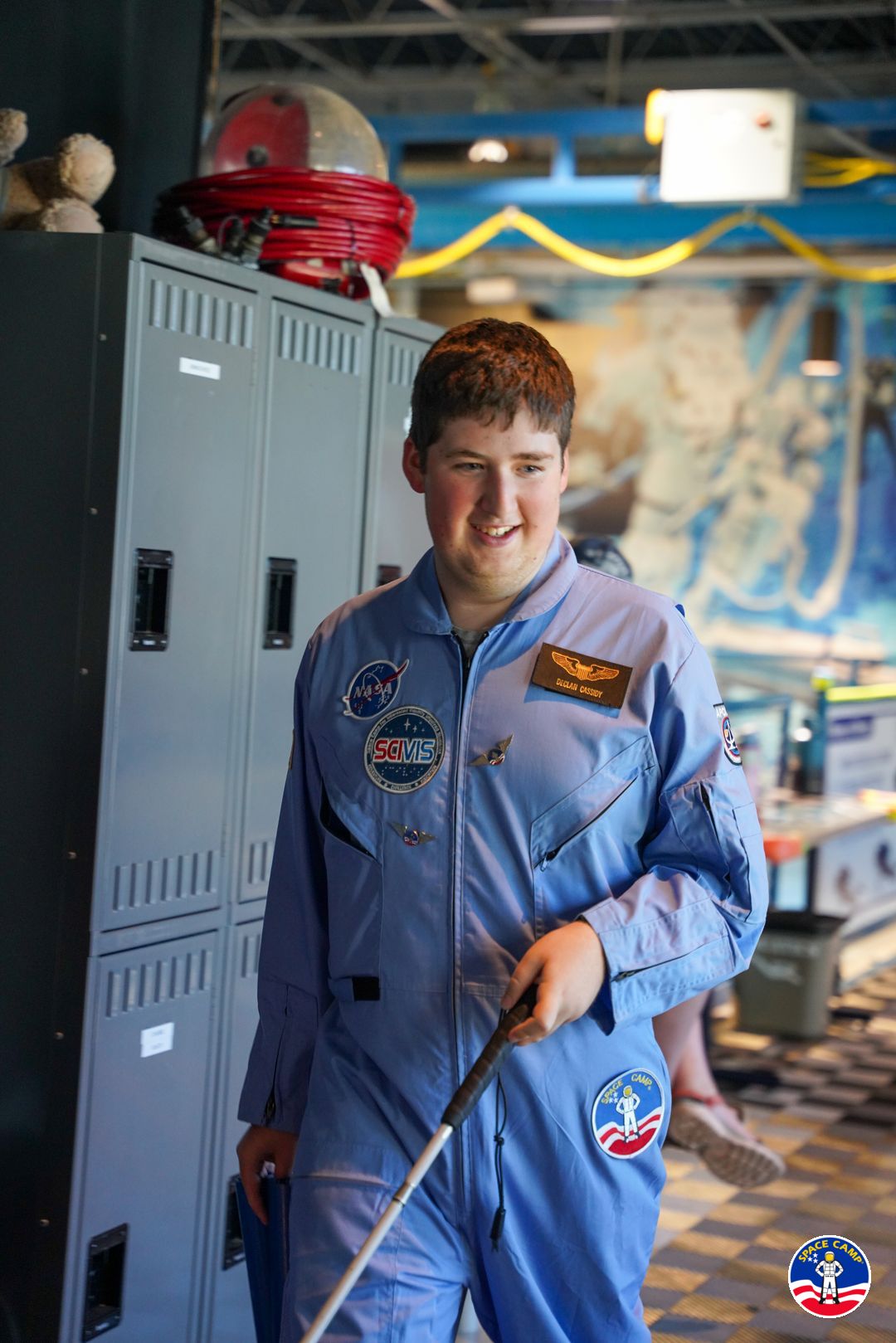
I’ve always held a strong interest in astronomy and the vast secrets of outer space, but the last thing I ever thought I could do would be attending Space Camp at the US Space and Rocket Center in Huntsville, Alabama.
I’d heard about it online and such, but before I went to Perkins, I never knew what Space Camp did for blind and visually impaired students.
How it all took off
2025 was the 35th anniversary of blind students attending Space Camp – and that’s thanks to SCIVIS, Space Camp for Interested Visually Impaired Students.
In 1988, a letter landed on the desk of Edward Buckbee, the founder of Space Camp. The letter, written by a woman who had been denied participation due to her visual impairment, had been forwarded by her Congressperson.
Mr. Buckbee didn’t just put the letter down. He reached out to the West Virginia School for the Blind and tirelessly worked to get students with visual impairments onto Space Camp grounds.
In the 1990s, students from the West Virginia Schools for the Deaf and the Blind began attending Space Camp, but it didn’t stop there – since then, thousands of blind and visually impaired kids have attended camp.
While Space Camp happens all year round, SCIVIS is only once a year. But Dan Oates, director of SCIVIS, and everybody else on the SCIVIS team truly work all year around to support this amazing program and make it accessible.
The work the team does can never go unnoticed: The tech team who ensures there are screen readers and magnification software working on all computers on the mission floor, Braille Central who ensures there is braille and large print everywhere from the dining hall to the mission floor to the dorms, and finally just the work from everyone ensuring that us blind and visually impaired students have the accommodations we need to experience Space Camp just the same as other sighted students.
My experience with the magic of SCIVIS Space Camp
Over the three years I attended SCIVIS, I have made so many friends, so many memories, and learned so many skills that will all last me a lifetime.
SCIVIS has taught me that there is a place for me out there where I can be educated on astronomy and being an astronaut. Even though right now, NASA has strict barriers that all astronauts are required to have 20/20 vision, you never know what the future holds.
If you are thinking about going to SCIVIS or thinking about sending your student, I 100% recommend it. It is a truly life changing and inspirational week that everyone should have the opportunity to experience.
I’m going to leave you all with Space Camp’s motto that perfectly encapsulates the program and what they do: “Just because I can’t see the stars, doesn’t mean I can’t reach for them.”
About the author
Declan Cassidy is 17 years old. When he was two years old, he was diagnosed with an optic tract glioma that he says limits his vision, but not his potential.
For six years, he’s attended Perkins School for the Blind, which has opened up many opportunities for him.
In his free time, he enjoys riding, creating art, and fighting for disability rights as a member of various disability organizations.
Get to know Declan better: connect with him on Facebook and read his previous #MyBlindStory post, Disability Pride is more than a Month.