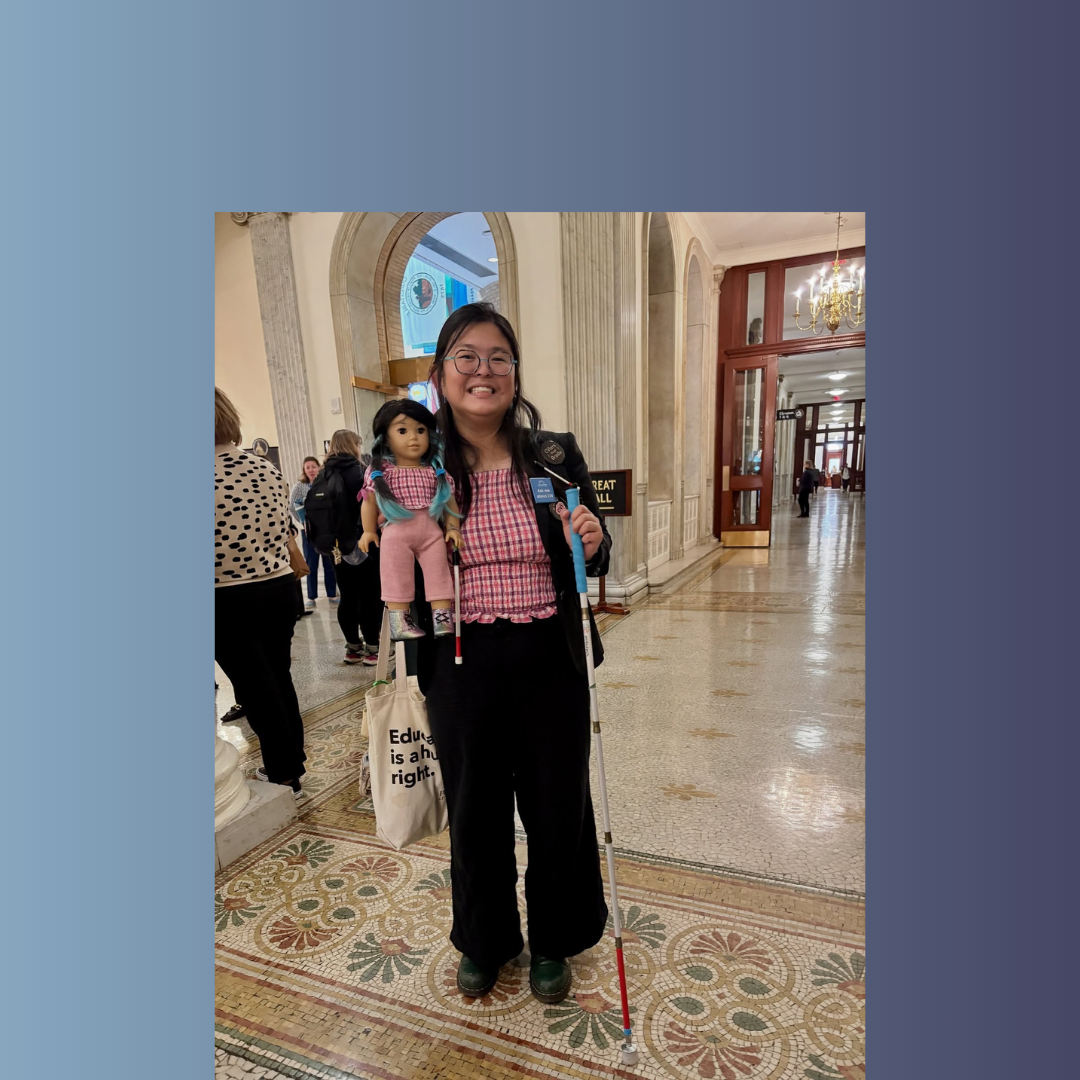
These days, I love my white cane – but that wasn’t always the case. This is the story of how the cane came into my life, and became part of finding the communities where I belong.
The broken foot incident (or, “how it became clear that I needed a white cane”)
It was late August of 2017 and I was having a blast at Camp Kesem, a special week-long sleep away summer camp run by college students for kids with parents who are affected by cancer. I was there because I’d lost my dad to cancer at 14. But when I was at camp, I never felt alone, because I was surrounded by others who understood. In fact, sometimes I forgot that it was “special.” I just felt like a kid at summer camp having fun with my friends and singing silly songs.
On the last day, during a break from “messy wars,” I was getting my water bottle when suddenly a younger camper ran in front of me. I didn’t see them because they came at me on the left, which is my blind side. I’ve got no peripheral vision. I tried to stop but we collided. It hurt – a lot – and I yelled a not-so-camp-appropriate word, but I continued to participate until the end of camp activities.
After camp, I went to the doctor where I learned that I’d broken my foot and ended up in a boot. A few days later, I went to the Perkins Low Vision Clinic and the eye doctor asked me what happened. Based on the story and their test results, one of their suggestions was that I start using a white cane.
Coming to terms with the white cane
I was lost. At that point, I still didn’t feel like I had a proper diagnosis for why I couldn’t see – the only thing that was confirmed was congenital nystagmus, and the suggestion to start using a white cane was so daunting.
Despite not knowing why I couldn’t see, I asked my mom to reach out to the Carroll Center to get me orientation and mobility (O&M) training.
Starting to use a white cane changed my life. I was no longer bound by when the sun set and I could stay out later. I could be more independent.
But soon after I embraced the cane, I also got my official diagnosis of Cerebral/Cortical Vision Impairment (CVI). And once again, I was lost – I didn’t know what CVI was and, at the time, I didn’t understand that it is a type of blindness.
I was also in deep denial, especially since I was about to go off to college: I didn’t want to be seen with a mobility aid. I was ashamed of my CVI and being a white cane user.
During this time of denial, I ran one season of D3 cross country. And I ran without knowing about adaptive sports, including tether running. If I had known about tether running with a guide, I probably wouldn’t have been a fall risk and would have injured myself less. And as the slowest on the team, I felt like I didn’t belong. I had never run in my life and was constantly being bullied by the faster runners for being slow and a newbie. Despite that, I quite enjoyed running as an outlet for myself.
Accepting my cane and my condition, finding my community
In the winter of 2020, everything started changing for the better. A parent in the CVI community affiliated with CVI Now reached out to me to write an article about my photography. Soon after, in a photo class at Mass Art, I did a project about how I see with CVI.
I realized that I have a voice and a seat at the table in the CVI community.
In 2022, I finally got to experience adaptive running via Achilles International. When I came upon their local chapter exhibiting at Boston ADA Day, I knew I’d finally found a team where I belonged, regardless of my pace.
Since then, things have continued to get better:
- At the Perkins CVI Conferences, I’ve presented, given an artist talk, sold my photos and connected with so many CVIers.
- I did a summer Internship at Perkins CVI Center via Mass Commission for the Blind.
- I filmed Love on the Spectrum season 3 – and met my girlfriend Pari.
- I had the honor of speaking at the first-ever CVI Awareness Day at the Massachusetts State House with CVI Now.
I have finally found a community to call home and I’ve started to feel less alone in my CVI journey. I’ve also made some beautiful connections – I’m close friends with CVIers and parents of CVIers, as well as other allies who care deeply about CVI.
It took eight years to accept that I, in fact, do have CVI. And seven years since embracing my friend the white cane. It has been a journey filled with struggles and joys. But most of all, I’ve figured out what it means to be proud to be blind and to use a white cane.
About the author
Tina is a fierce, fearless, outspoken advocate, athlete, artist and photographer who lives in the Boston area.
Want to get to know her better? You can follow her on Instagram. Watch her fall in love with her girlfriend Pari in season 3 of Love on the Spectrum. And read her previous #MyBlindStory posts, No one’s like me: Where’s CVI representation in the blindness community? and Living with CVI: What is the Definition of Blindness?.