When people who are blind read Roxie In Color, I want them to experience a very specific moment.
The moment when they smile and think, “A blind person definitely wrote this. This has to be an inside job.”
That’s because the blind characters in Roxie In Color don’t just use white canes, guide dogs, braille, and their other senses (though, of course, they do those things). But they also deal with rideshare drivers who refuse to transport guide dogs. They discover their child’s school calendar is posted on the website as an inaccessible PDF document. They explain why they choose to use a white cane instead of a guide dog, and why they’re tired of complete strangers opining that they should get a guide dog because it would make them “more independent.” They attend ACB and NFB conventions, have decades-long friendships from their involvement in the blind community, and enjoy the easy camaraderie that comes from shared experience.
The opportunity to write a novel with this kind of accuracy came from an unexpected collaboration.
In 2018, Diane Debrovner, who was then the Deputy Editor of Parents magazine, contacted me while researching an article about parents who are blind. At the time, I was serving as Chairperson of the Blind Parents Group of the National Federation of the Blind. Diane interviewed me and my husband Greg (who is also blind), along with about a dozen other parents for what became the May 2019 cover story, “What Blind Parents Want Us to See.”
After the article was published, Diane and I stayed in touch. She knew I enjoyed writing, both professionally through my work in public policy and as a freelance writer. Several years later, she approached me with an idea: What if we wrote a middle-grade novel together featuring a family with blind parents? It was exactly the kind of story I had always wanted to see on bookstore shelves.
Meet Roxie in Color
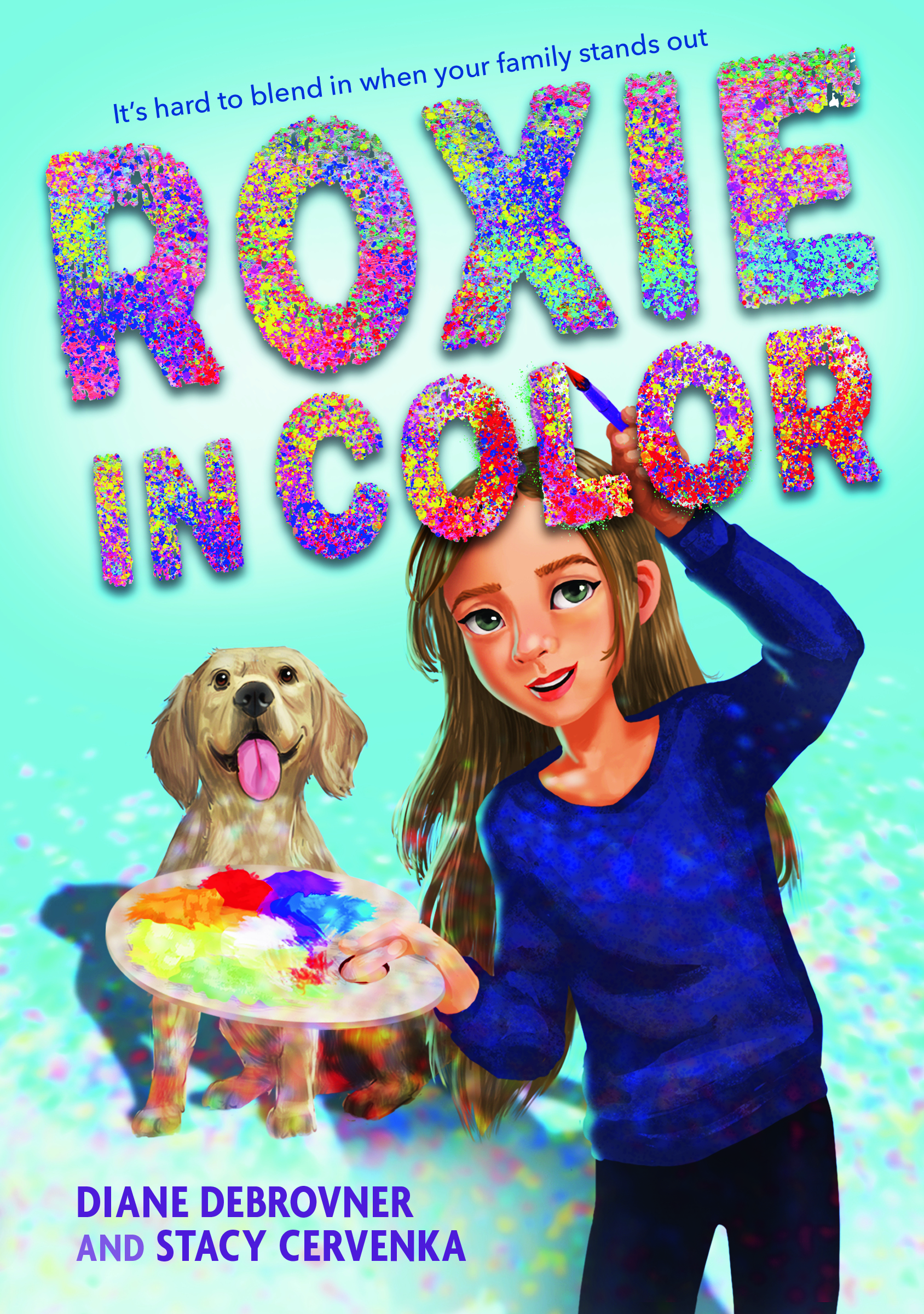
Roxie In Color is about a 12-year-old girl named Roxie Glass who moves to a new town on Long Island, New York and is about to start seventh grade at a new school. At her previous school, Roxie felt like people only thought of her as “the girl with blind parents,” so she decides not to tell her new classmates about her parents’ blindness until they actually get to know her.
Of course, since her mom and dad are both active in the community, this is harder than it may seem. Her mother Penny is a psychologist who has a new book coming out about building a stronger marriage. Her father Joe is a software engineer who is into rock-climbing. Roxie is also grappling with whether to take the genetic test to determine whether she will inherit retinitis pigmentosa from her mother.
Throughout the book, the reader learns about the many tools and techniques her parents use as well as some of the systemic and interpersonal issues they face. We meet blind YouTuber Leena Bannerjee and her parents’ friends the Novaks, another blind couple who have both sighted and blind children. Some of the chapters are even written from the perspective of her mother’s guide dog Nash!
As the story progresses, Roxie and her friends have a sleepover and make some unwise choices. When a neighbor reports Roxie’s parents to Child Protective Services, Roxie has to learn not only to own what makes her and her family unique, but also to stand up against an unfair system.
Like many of us in the blind community, Roxie has to move from a place of internalized ableism to advocating for herself and her family.
Getting blindness right
As a blind parent and also through my work with the NFB Blind Parents Group, I saw on a daily basis how the many misconceptions society has about blind people had a real and concrete impact on the lives of blind parents and their children.
Parents sometimes faced hospital staff and social workers who were reluctant or unwilling to allow them to leave the hospital with their babies after giving birth. Sighted parents sometimes didn’t allow their children to have playdates or sleepovers at the homes of kids whose parents were blind. Blind parents sometimes weren’t asked to volunteer for classroom parties, school dances, or after-school clubs, which led to their kids feeling confused and upset.
In my previous jobs as Director of Public Policy for the American Foundation for the Blind and the Senior Director of Policy for RespectAbility, a big part of my job was helping members of Congress understand barriers that blind, low vision, and disabled people face and what could be done to remove those barriers. This often meant distilling very complex systemic issues into quick, easy-to-understand anecdotes that I could share with a member of Congress in a 30-minute visit. In many ways, lobbyists have to be good storytellers in order to help policymakers with little knowledge of a particular issue understand quickly how people are impacted.
I came to find this was a very useful skill when co-authoring Roxie. Many of the book’s readers may never have met a blind person; they may know very little about certain aspects of our lives. I had to be able to communicate succinctly, for example, how lack of public transportation might impact a family without writing paragraphs upon paragraphs about that issue.
Two items that were important to me to include in the book were the social model of disability and the fact that there is a close-knit and vibrant blind community.
As in real life, most of the challenges Mom and Dad face are not due to not being able to see. The logistical challenges of blindness can often be reduced or eliminated with the right tools and strategies. The most significant, damaging problems faced by blind parents are due to the misconceptions, bias, and discrimination that exist. I wanted to be sure this was spelled out directly by having one of the blind characters say, “For most of us, the hardest part about being blind isn’t not being able to see—although, yeah, that can be frustrating sometimes. It’s dealing with all the stereotypes and misconceptions people have.”
On a personal level, I often think of my blindness less in terms of the physicality of it and more in terms of the community I am a part of. We share a common history, navigate the world in the same way, and recognize experiences that are instantly familiar to one another.
Many of my blind friends and mentors feel like family. My kids know other families with blind parents and attend blind community events. I wanted to be sure that sighted readers didn’t think that Roxie’s family was completely singular or intrinsically “different.” They simply belong to a different community. This is why it was so important to me to have another family that also included blind parents and for Roxie to be aware of some of the staples of blind community life, such as ACB and NFB.
What I hope readers will take away from Roxie
Roxie In Color is a middle grade novel, which means that most of the book’s readers will be sighted middle school students. I want them to see that their blind and disabled classmates want the same kind of futures they do with marriages, jobs, and kids of their own. I also want them to see that it’s best not to judge people (whether based on disability, race, religion, or immigration status) without knowing them and having all the information.
The kids who read Roxie will also be the parents, teachers, and social workers of tomorrow. Perhaps when they one day have the opportunity to date, hire, or work professionally with a blind person, they’ll remember Roxie’s parents and give that person a chance.
Of course, as I was writing the book, I also thought a lot about the blind and low vision kids who will be reading it. At the beginning of the book, Roxie wants to keep her parents’ blindness a secret from her classmates until they get to know her. I wanted to be sure that blind kids reading this didn’t come away with the implication that blindness is shameful or embarrassing or something people should naturally want to hide. We made sure readers would understand that Roxie’s parents are busy, happy, capable people and it’s not their blindness that is truly the problem, but the ableism around her that Roxie has internalized.
Where should blindness representation go next?
No single book can capture the full breadth of blind experience, and Roxie in Color was never intended to do so.
The blind community is a cross-section of society. You’ll find blind people of every race, ethnicity, religion, political persuasion, sexual orientation, gender identity, immigration status, and socioeconomic background. We live in rural communities and major cities. Some of us are lawyers and engineers. Others struggle to find work because of inaccessible transportation, inadequate educational opportunities, low expectations, difficult-to-navigate and bureaucratic vocational rehabilitation systems, or employment discrimination. Our experiences with blindness are shaped not only by our vision loss, but also by every other part of who we are.
Roxie’s family is white, middle-class, and lives on Long Island. I would love to read stories about blind families living in rural America, on tribal lands, in immigrant communities, or in neighborhoods where poverty shapes everyday decisions. I’d love to see more authors use fiction to explore the intersection of blindness and class, showing how systemic barriers often limit opportunity and contribute to economic hardship for many blind people. More broadly, I hope to see stories that depict the many ways blindness intersects with race, class, culture, language, faith, and geographic place.
The more authentic blind stories we tell, the less any one book has to stand in for all of us. Authentic representation isn’t achieved when one book gets blindness right. It’s achieved when there are enough accurate, authentic books that no single one has to represent an entire community.
Get your copy of Roxie in Color
It was very important to Diane and me that the book be available to blind and low vision readers on the same day as it was released in print. Roxie In Color is available as a Kindle e-book and as an audiobook through Audible, Penguin Random House Audio, and wherever audiobooks are sold.
Blind and print-disabled readers can also borrow the book free of charge through the National Library Service for the Blind and Print Disabled (NLS). Thanks to the support of Kim Charlson and the Perkins Library, the book is available nationwide through the NLS network in hard-copy braille, on digital talking-book cartridge, and through BARD in both electronic braille and audiobook formats. We are deeply grateful for their partnership in helping make the book accessible to blind and low vision readers across the country.
The print hardcover edition of Roxie In Color can be purchased through Candlewick Press and major online booksellers, such as Barnes and Noble, Bookshop.org, and Amazon, as well as many independent bookstores across the country, such as Sower Books and Books Of Wonder.
Although the hardcover is printed in standard print, we chose the Atkinson Hyperlegible font, developed by Braille Institute, because of its enhanced readability for many people with low vision. A large-print edition using the same font will also be available in the coming months.
Do you want to write a novel?
If you would like to contribute to more and broader portrayals of blind and low vision people in fiction, here are some resources to get you started:
- QueryTracker: The first step to getting your book published is to find a literary agent who has connections in the publishing industry. This is a free database that helps authors find literary agents and track submissions. It also includes comments from other writers about their experiences with agents.
- Manuscript Wish List (MSWL): Agents describe exactly what kinds of manuscripts they’re hoping to find. It’s one of the best places to identify agents who might be interested in your work.
- Association of American Literary Agents: Information about what literary agents do and why they matter.
- Jane Friedman: An all-around resource on traditional publishing, literary agents, book proposals, and publishing contracts. Her articles are widely respected in the industry.
- Writer’s Digest: Offers articles on writing craft, querying agents, publishing, and marketing.
- Reedsy Learning: Excellent free articles on plotting, character development, editing, and traditional publishing.
About the author
Stacy Cervenka is the director of the Iowa Department for the Blind and previously led the Blind Parents Group of the National Federation of the Blind. She divides her time between Des Moines and Lincoln, Nebraska, where she lives with her husband and two children. Just like Roxie’s family, Stacy and her husband, Greg, are blind, while their children, Leo and Josephine, are sighted.
To keep up with her work, follow her on Instagram.
You can also check out her previous #MyBlindStory post, We’re Bad Blind Moms and We Know It!