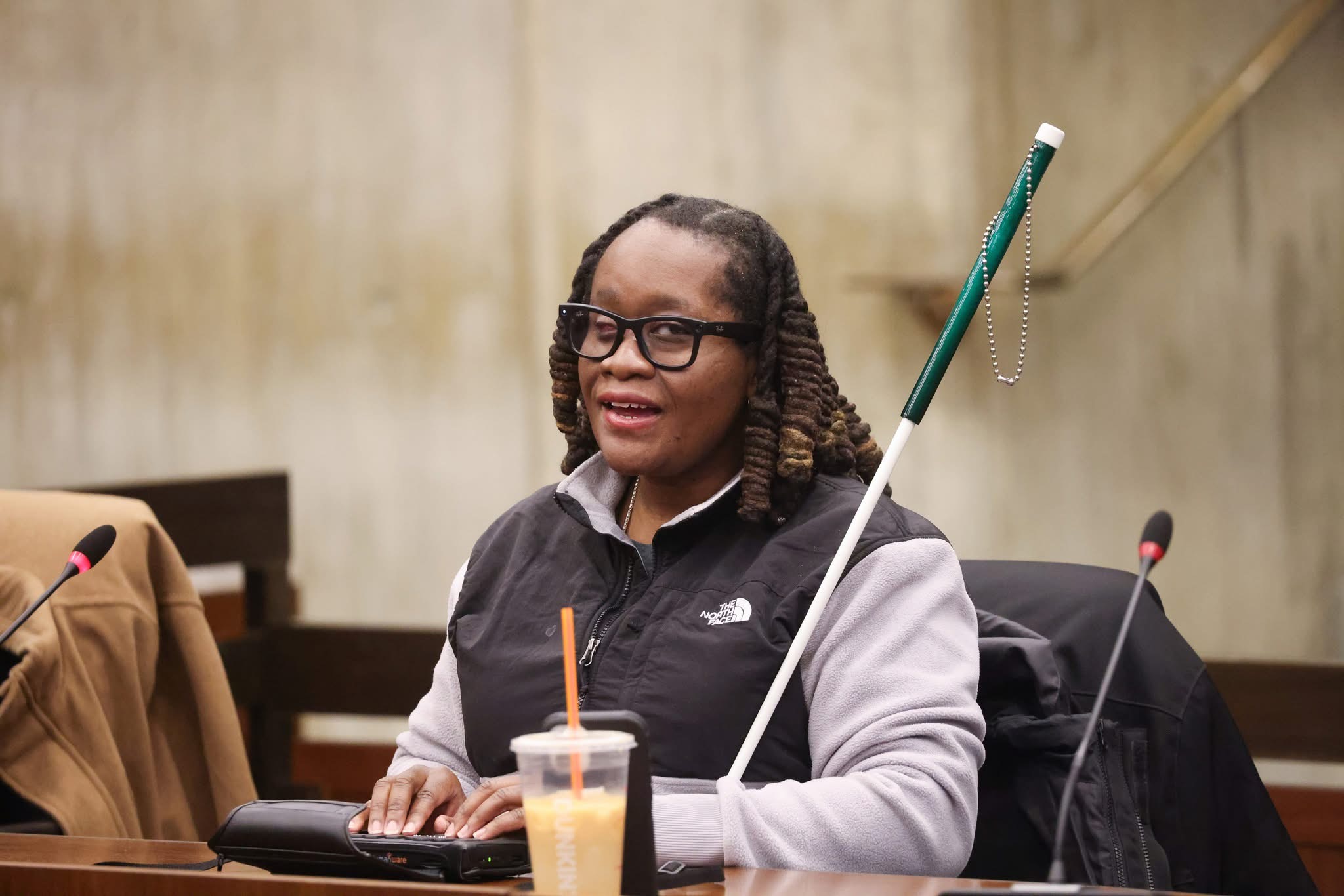
For me, connection is a lifeline. As a 36-year-old disability advocate living in Boston’s North End, I navigate the world with significant combined hearing and vision loss. It’s my honor to serve on multiple executive boards across Massachusetts, where my voice brings awareness to the deafblind community.
But life wasn’t always this way. Before I discovered the free products and services I’m eligible for through iCanConnect, the National Deaf-Blind Equipment Distribution Program, my world felt much smaller and significantly darker.
From disconnected to iCanConnect
I remember feeling disconnected from the world around me. There was nothing worse than feeling isolated while being surrounded by so many people. Then, one day while attending a local training center, a colleague recommended I check out iCanConnect.
The program provides free distance communication technology and free training to help people with significant hearing and vision loss stay connected with their loved ones, communities and world. To be eligible, you must have significant combined hearing and vision loss, as well as meet federal income guidelines.
After I applied and was accepted into the program, I met with my local iCanConnect representative for a personal assessment to review my distance communication needs and goals. Through the program, I received a free braille device, computer, and smartphone. I also received free one-on-one training to make sure I could use my new equipment for distance communication purposes. While the initial training session was foundational, it gave me the confidence to keep learning about my technology and maximize its potential. Now I have the confidence to navigate new tech on my own.
Confident, connected and ready to advocate for my community
Today, I use the equipment daily for nearly every aspect of my life. I stay in constant contact with my family, friends, and fellow community members through text. Most importantly to me, this technology fuels my advocacy work. I use my braille device and computer to draft and deliver speeches, amplifying the voices of the disability community. I consider my technology to be like the air I need to survive.
iCanConnect’s arrival in my life was like a lighthouse during a dark storm. It provided the guidance and tools I needed to navigate a world that had felt increasingly out of reach.
Because of this, I am a passionate supporter of iCanConnect and frequently recommend it to others. I truly believe that access to information and communication should be a fundamental right. Having iCanConnect in my life has been an amazing experience. Access to information should never be restricted, and communication through technology should never be limited.
About the author
Casandra Xavier is an outspoken disability advocate, athlete and strong voice for her community in Boston, Massachusetts. To keep up with her adventures, follow her on Instagram.
About iCanConnect
iCanConnect is a national program with local contacts that provides free distance communication equipment and training to qualified individuals who have significant combined hearing and vision loss.
For more information, or to see if you or someone you know qualifies, visit iCanConnect.org or check out this video. You can also follow iCanConnect on Facebook, X, TikTok, and YouTube.
For more insight into real-world experience with iCanConnect, read these #MyBlindStory posts from Larry Faunterloy, an event coordinator and activity liaison from Baltimore, Dallas, a teen boy in Minnesota, Burgon Jensen, a teacher, self-taught crochet artist, and motivational speaker from Draper, Utah, and Matthew Harris, a poet and author from Glen Burnie, Maryland.